Originally written in French, Tatiana de Rosnay wrote Sarah’s Key as a tribute to the children and victims of the Vel’ d’Hiv’ roundup during 1942. It was written to those who never came back, and the ones who survived to tell their tales. Inspired by the historical dark deeds of Paris, Tatiana stumbled upon a website describing the rue Nelaton, in the 15th arrondissement, close to her residence. It was where the tragic events of Vel’ d’Hiv took place in 1942. Written as historical fiction, the author rotates back and forth between two stories regarding a journalist in 2002 and a Jewish child who experienced the horrors of the Vel’ d’Hiv. In many ways, this book is informative with unique information concerning France’s role during the Holocaust, yet it doesn’t fail to provide an emotional connection between the audience and its fictitious characters (not based on a true story). A recurring theme amongst Tatiana’s stories is family. In books such as Sarah’s Key, A Secret Kept, The Rain Watcher, and A Paris Affair all explore the relationships between families and their secrets. From her writing, Tatiana excels at creating issues and plots dealing with marriage, siblings, and parenthood.
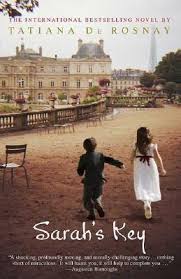
Sarah’s Key revolves around Sarah and Julia. Sarah was a ten-year-old Jewish girl taken away during the Holocaust, whereas Julia was a journalist investigating the Vel’d’Hiv roundup. In Sarah’s storyline, most of her side-characters were drawn as two-dimensional. As for Julia, her family is painted with more descriptions and significance. The Tezacs are discussed with a richer history and are shown in a wider range of emotions. Many of her characters have a clear development, even insignificant figures who merely provide a platform to enrichen the connection between Sarah and Julia.
A major theme the book circles around is grief. From the introduction of the horrors of the Vel’d’Hiv to the deaths during the Holocaust, grief is experienced throughout the book by the majority of characters. Not only did the author excel in painting each character with grief, but her ability to capture their emotions and expressions of grief allowed me as a reader to empathize and emotionally connect with the fictitious characters.
Sarah’s Key focuses on two plots. Both have their unique styles and voices. The author did exceptional work with the timing of each character’s introduction, as it added value to the plot whilst revealing secrets during suitable spots. For Julia, she has multiple subplots that enrich her character development. The different complications she experiences provide readers with multiple areas containing suspense and sub-climaxes. They thoroughly explore her different concerns, and how it affects her approaches and decisions.
Sarah, born in 1932, lived in a time of despair. Aged 10, her story consisted of solely concentration camps and mental torture. This setting effectively develops Sarah into a cold character, a necessary quality that helps the plot develop. As for Julia, her story starts off in Paris, 2002. She had the chance to research the Vel’d’Hiv in France, and discovers a connection between her life and Sarah’s. Her family members provide an effective setting for Julia to continue her discoveries in the association between her and Sarah, whilst also providing issues regarding her own personal life.
The final copy of Sarah’s Key was formatted in a creative way, with Sarah’s story and Julia’s switching back and forth from chapter to chapter. This type of formatting is effective for the author to reveal the book’s mysteries so that neither plots would reveal spoilers too early nor too late. The imagery painted throughout the writing is done effectively, as the author is able to prolong a moment to further provide readers a clear image of each scene. The vocabulary the author uses is mature but common, with words such as blatant and velour being the most challenging.
The reading level for Sarah’s Key isn’t high, but it is inappropriate for children under the age of 12. It deals with issues relatable to parents and adults, and the level of maturity required to read this book is high. I would recommend Sarah’s Key to mature students and adults interested in a book providing an emotional connection between the characters and its readers.

Thoughts:
When writing my book review for Sarah’s Key, I felt like I had a lot to say because of my interest in the book and the satisfaction I received from the book. However, the implementation of a 500 word limit on this piece of writing forced me to put my thoughts into a clear yet concise manner. I was unable to write my full detailed analysis of the book, but instead, summarize the main points of my thoughts and ideas. It was frustrating at first, but I was able to adapt and identify the main points of my analysis.
 Mok, Ho Lam Edwin Writing Block
I enjoyed reading this book review. Perhaps, I will pick it up from the library in my spare time. I’m glad that you picked up the major theme of the book. I’m glad that you were able to empathize and emotionally connect with the fictitious characters, I get that when I’m reading a really good book.
LikeLike